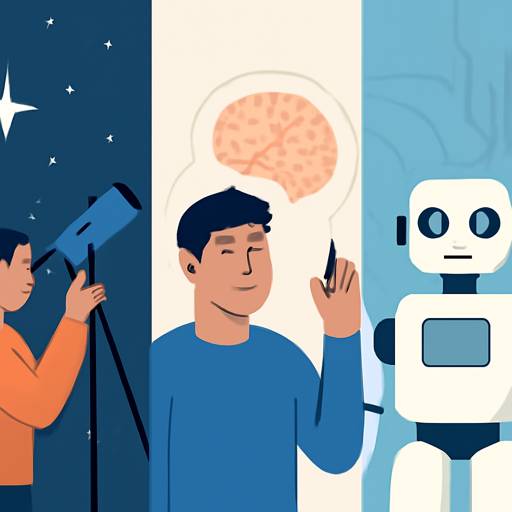
Big questions drive great learning. How do new worlds form? Why does attention slip under pressure? What makes a group of simple robots behave like a single intelligent organism? This guide maps out practical, high-impact directions across three fast-moving fields—astronomy, cognitive science, and robotics—so learners can transform curiosity into publishable work, competition-ready builds, or standout portfolio pieces. With open datasets from major observatories, low-cost lab methods, and accessible tools for prototyping, students can tackle authentic research while mastering analysis, design, and communication. Along the way, targeted prompts, real-world examples, and tested workflows reveal how to turn ideas into evidence and concepts into creations. Whether the goal is a science fair, a capstone, or an independent study, these projects are designed to be rigorous, replicable, and genuinely exciting.
Astronomy Research Ideas and Space Telescope Projects You Can Actually Do
Modern sky surveys and space observatories have opened a treasure trove of data perfect for ambitious student work. Begin by framing a clear question: Do certain star types host more short-period exoplanets? How does dust reddening vary across a chosen field? Are there periodicities in a variable star that suggest multiple pulsation modes? From there, free archives unlock professional-grade resources. NASA’s MAST portal hosts Hubble, TESS, and now JWST datasets; ESA’s Gaia provides exquisite astrometry and photometry; Pan-STARRS and ZTF supply transient alerts and light curves. With this access, students can produce original analyses aligned with Space Telescope Projects without needing a personal observatory.
Practical workflows make these astronomy research ideas tractable. For exoplanet candidates, download TESS light curves and use Python packages like Lightkurve to clean data, search for transits, and estimate planetary radii from transit depth. For variable stars, perform period finding (Lomb-Scargle) and compare classifications against catalog labels; discrepancies can signal misclassifications worth reporting. Cross-match Gaia color-magnitude data with variability types to infer stellar evolution stages. Interested in galaxy work? Use Hubble imaging in a single field to quantify the morphology-density relation: crowdsource morphological labels with classmates, compute concentration/asymmetry metrics, and correlate with local galaxy density.
Hands-on instrumentation is also within reach. Build a cardboard-and-CD spectroscope to record stellar spectra with a phone camera; identify absorption lines and estimate surface temperatures. Try DSLR photometry of bright variables or asteroid occultations with a tripod and intervalometer; stack and calibrate frames with AstroImageJ to generate light curves. Radio astronomy clubs can set up a small software-defined radio to detect solar flares or the 21-cm line, introducing students to frequency-domain analysis. Finally, leverage citizen-science platforms—Planet Hunters, Galaxy Zoo—to learn labeling heuristics, then graduate to your own pipelines that replicate and extend published findings. Throughout, document methods, uncertainties, and validation steps; robust error analysis is the difference between a cool plot and a credible result.
Cognitive Science for High School: Design Experiments That Answer Real Questions
The brain is a hypothesis-generating machine, and so is a good cognitive science for high school project. Start by identifying a construct you can measure rigorously—attention, working memory, decision bias, or language processing. Define a testable prediction: Does background noise impair digit span more than visual clutter? Will time pressure increase risk-seeking in ambiguous choices? Can color-word interference (Stroop effect) be reduced by mindfulness breathing? Then select a validated task or build one with open-source tools: PsychoPy, PsychoJS/jsPsych, and Gorilla allow precise stimulus presentation and millisecond timing in the browser or lab.
Structure your experiment for reliability. Pre-register your hypothesis, design, and analysis plan on a platform like OSF to guard against HARKing. Use power-aware sample sizes—small-N designs can still be meaningful if they are within-subject and counterbalanced. Randomize trial order, control luminance and font size, and standardize instructions to minimize confounds. Choose robust dependent variables: reaction time distributions (trim extreme outliers), accuracy, d-prime for signal detection, or drift rates from simple diffusion models. Analyze with JASP or R, report effect sizes and confidence intervals, and visualize results with clear, labeled plots.
Classic paradigms are perfect launchpads with room for novelty. Replicate the Stroop or Flanker effects and add a twist: compare digital versus paper presentation, manipulate stimulus contrast, or introduce dual-task loads to probe attentional bottlenecks. Explore memory by testing spaced repetition versus massed practice using word lists; extend by tracking retention across days to model forgetting curves. Investigate perceptual phenomena like change blindness using brief masked intervals; quantify detection thresholds and relate them to individual differences in visual working memory. Ethical practice matters: obtain permission, anonymize data, and ensure tasks are low risk and debriefed. Finally, tie insights to technology. Human attention limits inform cockpit interface design; memory strategies influence educational app UX; bias in decision-making maps onto algorithmic fairness. By connecting lab results to design principles, students transform a data table into a story about minds—and the systems they use every day.
Humanoid and Swarm Robotics for Students: From Balancing One Bot to Orchestrating Many
Two compelling tracks let learners explore embodiment and coordination. In humanoid robotics for students, the core engineering challenge is control under constraints. Start with a 2–4 DOF leg prototype using micro servos and a microcontroller (Arduino, micro:bit) to learn joint control, inverse kinematics on a plane, and basic gaits. Progress to IMU-based balance with complementary or Kalman filtering; add a PID controller to stabilize pitch/roll while stepping. Computer vision with a lightweight model (MobileNet) on a Raspberry Pi can enable line following, object approach, or AprilTag localization. For interaction, integrate wake-word recognition and a simple dialog loop; study human-robot interaction by measuring task completion time, user trust ratings, and perceived workload (NASA-TLX) under different voice tones or gesture sets.
On the collective side, swarm projects demonstrate how simple rules yield emergent intelligence. Begin in simulation (CoppeliaSim, Webots, or ROS 2 with Gazebo) to prototype flocking, dispersion, aggregation, or foraging behaviors. Implement Reynolds’ rules—separation, alignment, cohesion—and quantify outcomes using metrics like cluster count, nearest-neighbor distance, and coverage ratio. Transition to hardware with small, identical robots: micro:bit rovers, e-puck clones, or DIY kilobot-style disks. Communication can be IR, Bluetooth mesh, or ultra-wideband; choose one and enforce bandwidth and range limits to stay realistic. A powerful lesson: remove global positioning and force agents to rely on local sensing and stigmergy (e.g., LED beacons or ground markers), then test robustness under sensor noise.
Case studies make these goals concrete. A balancing biped that fetches and hands off objects demonstrates closed-loop control, CV perception, and safety-aware HRI. A 12-robot warehouse analog can simulate distributed task allocation: model shelves as resources, assign pick jobs using market-based auctions, and compare latency against a centralized planner. For field robotics, an outdoor swarm performing perimeter search can use bearing-only coordination and intermittent communication; evaluate success by area coverage over time and resilience to node failure. To accelerate progress, explore build logs, rubrics, and tutorials curated for students in Swarm robotics student projects, then adapt them with your own constraints and evaluation metrics. Throughout both tracks, emphasize rigorous experimentation: isolate variables, record firmware versions and parameters, and run statistically meaningful trials. The payoff is twofold—systems that work reliably, and evidence that persuades judges, mentors, and future collaborators.